Solving Kansas City’s Workforce Challenges, Together
Inside a KCBJ Panel on Talent, Trades and What's Next for the Kansas City Workforce
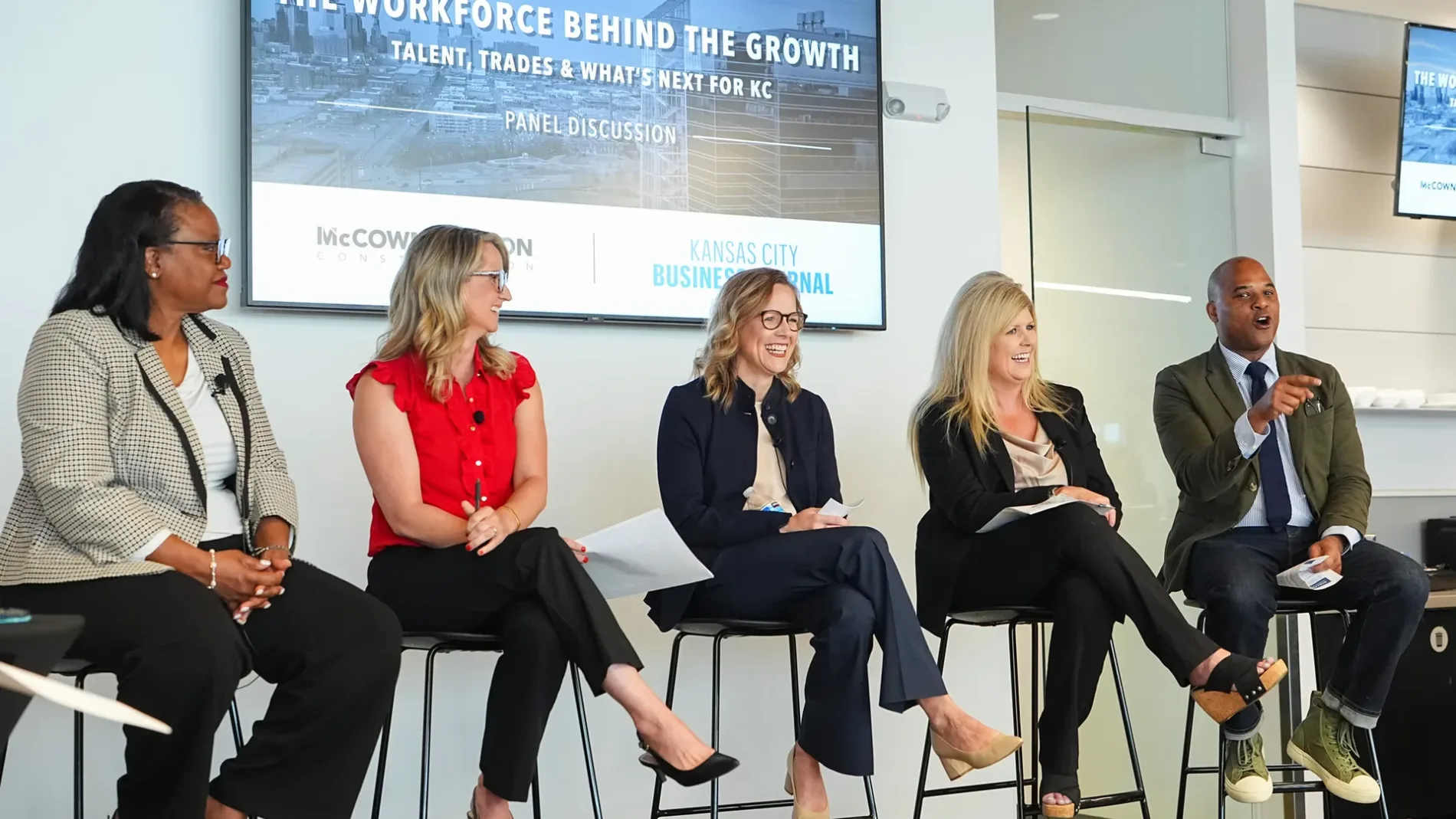
Put a hospital executive, a global electronics manufacturer, a community college chancellor, a trade association training director and a school superintendent in the same room, and you’d expect five different conversations about five different problems. At a recent panel discussion hosted at McCownGordon Construction, “The Workforce Behind the Growth: Talent, Trades & What’s Next for KC,” all five were navigating a similar challenge, and increasingly, reaching for similar solutions. Emily Brown, the company’s Vice President of Learning & Development, moderated.
“When I started nursing, there was a nursing shortage; 30 years later, we still have a nursing shortage,” said Susan Krug, Senior Vice President and Chief Nursing Executive at BJC Health System West Region (Saint Luke’s). What’s different today, she explained, is the “silver tsunami” of an aging population, creating more strain on an already tight system.
Jennifer Pozzuolo, Human Resource Manager at Garmin International, has watched a similar shift play out in electronics manufacturing. “When I started at Garmin 20 years ago, we could hand-select people that we wanted,” she said. A recession and a pandemic later, paired with a current “retirement battle,” Garmin now averages 300 to 400 open positions across its organization, underscoring a growing workforce shortage.
For construction, Dr. McDorman, Education and Training Director at The Builders — A Chapter of AGC, said labor shortages used to move with the economy, tight when times were good, easier when they weren’t. That’s no longer the case. She calls it a “triple threat”: an aging workforce, with 41% of the construction industry’s current talent expected to retire by 2031; a younger generation choosing construction trades less often; and a wave of new Kansas City projects with too few workers to build them.
Education is feeling it too. “I think everybody recognizes that nationally there is a teacher shortage in our country,” said Dr. Stubblefield, Deputy Superintendent for Shawnee Mission School District. Dr. Beatty, chancellor of Metropolitan Community College (MCC), feels a version of the same shortage from the instructor side, as qualified professionals are harder to keep in the classroom because they can often earn far more working in the field than teaching it. “Education, while it is a very valuable field for those who are in it, it doesn’t always return that value in your pockets,” she said.
Across healthcare, manufacturing, construction, K-12 and higher education, the panelists agreed the workforce challenges aren’t necessarily new. What’s new is the kind of creative problem-solving it’s going to take to fix it.
Rethinking the Pipeline
For years, the standard recruitment playbook was straightforward: recruit externally, offer better pay, wait for the next class of graduates to arrive. That playbook isn’t producing enough talent anymore. Today, recruiting starts further upstream, in how students are introduced to careers in the first place, and in how employers nurture the talent they already have.
That starts with exposing students to career options, long before they’re old enough to be hired. The Builders’ 90,000-square-foot Career Development and Exploration Center in North Kansas City is a training center designed to give students the opportunity to safely explore the trades before ever setting foot on a job site. “It’s not safe to have a 17-year-old on an active job site, so we have to think of ways to introduce students to construction in a safe, impactful way,” Dr. McDorman said.
Dr. Beatty pointed to MCC’s recently renovated Advanced Technical Skills Institute and a new Automotive Institute where students earn an industry credential before they even finish high school. Pozzuolo described a similar creative approach at Garmin, where students work part-time through high school and are frequently hired on at graduation, backed by apprenticeships, relocation packages for technicians and partnerships with the military to fill technical roles. Krug described a similar shift at Saint Luke’s, which traditionally partnered with colleges through clinical adjunct faculty, an approach that stalled out when COVID hit. Now, they’re focusing on partnerships earlier, at the high school level, providing real clinical exposure years before a student ever sets foot in a hospital. Dr. Stubblefield also described a shift toward “growing our own,” creating pathways for professionals already working in a school building to become a certified special education teacher, for example, rather than relying solely on outside hires.
Underneath all of it is a harder problem: widening the range of careers students and families see as worth pursuing in the first place. Dr. McDorman said construction employers need to do a better job telling the industry’s own story, making visible the career path from entry-level field trades to foreman, superintendent, project manager and beyond. “We need to stop talking about construction like a second-choice career,” she said. Dr. Stubblefield made a related point about how high schools present post-graduation options. Many students and families still default to assuming a four-year degree is the only path, he said, even as more students find real opportunity in the trades and other skilled careers that don’t require one. “It’s about educating families on the availability of these high-paying jobs, which won’t leave them drowning in debt,” he said.
Kansas City’s Competitive Advantage
Recruiting is only half the equation. Retaining talent, and drawing new people to Kansas City, means selling the region itself. “I think that’s where Kansas City wins, the values that are associated with living here,” Dr. Beatty said, pointing to affordability, good schools and a level of everyday friendliness she hasn’t found in other cities she’s lived in. Dr. McDorman agreed, noting that today’s workforce weighs work-life balance differently than previous generations did. “When you showcase the affordability of the Midwest and the fact that we do have everything from big league teams to entertainment, and you can afford to live here, that’s a big difference overall,” she said.
There’s room to build on that advantage, too. Pozzuolo pointed to transportation as one area where regional collaboration could make Kansas City’s pitch even stronger, particularly for candidates commuting across state lines. “I feel like our whole city together could improve that,” she said.
Technology That Makes Room for People
Every industry on the panel is leveraging technology differently, but they landed on the same conclusion: it’s not replacing people, it’s freeing them up for the parts of the job that matter most.
“It’s amazing what technology can do, not to replace people, but to allow them to shift their focus to human relationships and the things people are often too busy to do,” Dr. Beatty said. Krug sees the same principle in healthcare, where smart infusion pumps and electronic health records have cut a 15-minute manual drug calculation down to just over a minute, freeing nurses to focus on patient care rather than paperwork.
For Garmin, technology has raised the technical bar for entry-level roles. “Our autopilot can now land a plane without the pilot operating it,” Pozzuolo said. “The skill required to install that is way different than it was five years ago.” In construction, Dr. McDorman said a similar shift is playing out on job sites, where a foreman today must be as comfortable with an iPad as with a tape measure, using 3D digital models and real-time tracking to make better decisions, faster. Dr. Stubblefield sees the upside in classrooms too, where students often arrive more fluent in new technology than their teachers. “We shouldn’t stifle their curiosity, but engage these students so they can help us move forward,” he said.
Solving It Together
Despite the pressure points, there was real alignment on how the region can help close the workforce gap: closer, earlier collaboration between industry and education.
Dr. McDorman said construction must align with schools sooner and broaden the pitch beyond the trades themselves. “We don’t just need skilled trades,” she said. “We need the accountants. We need the marketing professionals.” Dr. Stubblefield framed it as a mindset shift, from being consumers of talent to co-producers of it, industries working alongside schools to close the gap between what’s taught and what’s needed in the workforce. For Pozzuolo, the answer is about relationships: recruit constantly, network with everyone in the room, and don’t be afraid to share good candidates even outside your own industry.
No single industry can solve today’s workforce shortage alone. It’s a regional challenge, and Kansas City’s employers, schools and civic leaders are already developing creative ideas to tackle it together.
Panel:
Emily Brown, Moderator, Vice President, Learning & Development, McCownGordon Construction
Susie Krug, Chief Nursing Executive, Saint Luke’s Health System)
Dr. Kimberly Beatty, Chancellor, Metropolitan Community College)
Dr. Eva McDorman, Training Center Director, The Builders — A Chapter of AGC)
Dr. David Stubblefield, Deputy Superintendent, Shawnee Mission School District)
Jennifer Pozzuolo, PHR, Human Resources Manager, Garmin International)